Wine label size: typical dimensions by bottle type
There is no single legal wine label size. Most front labels on a standard 750 ml bottle run roughly 3 to 4 inches wide and 3.5 to 5 inches tall (about 75 to 100 mm by 90 to 125 mm). Bottle shape, printer and style decide the rest.


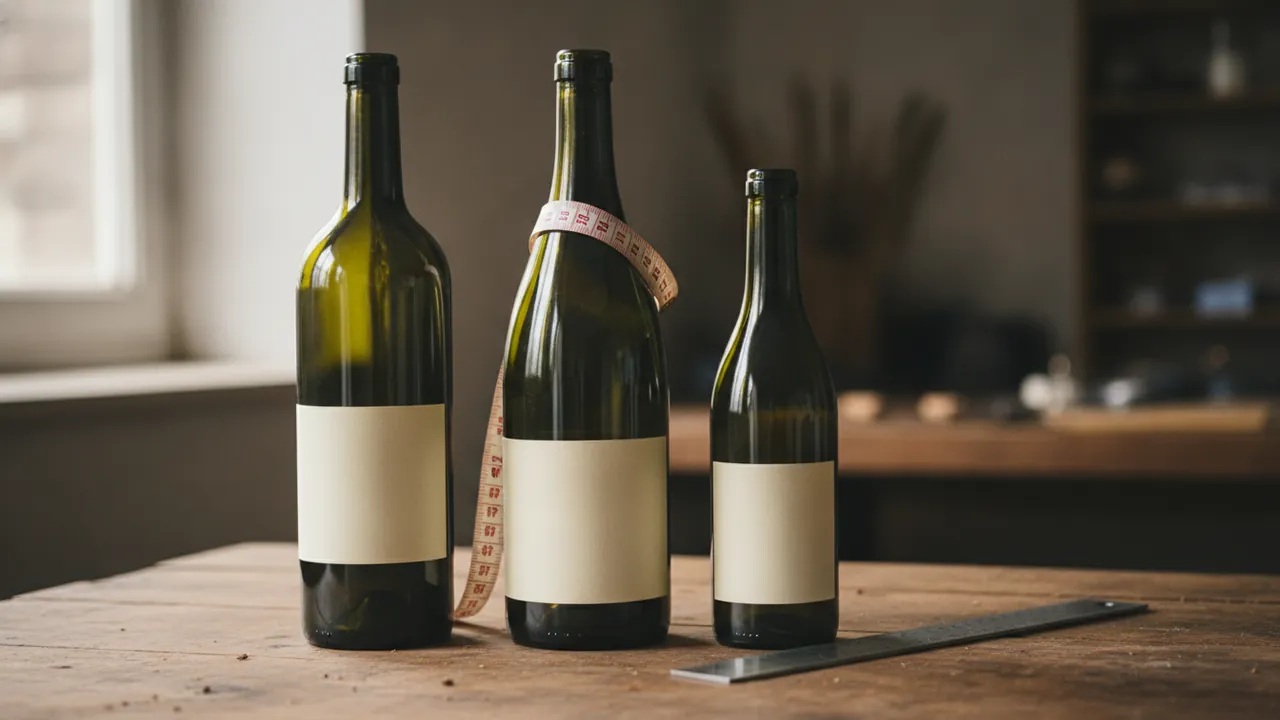
Typical wine label dimensions at a glance
Everything below is typical, not a rule. Printers and bottle makers differ, so treat each row as a starting range and measure your own bottle before you order anything.
| Bottle type | Typical front label (width x height) | Typical back label | Notes |
|---|---|---|---|
| 750 ml Bordeaux (straight sides) | 3 to 4 in x 3.5 to 4.5 in (75 to 100 mm x 90 to 115 mm) | 3 to 4 in x 2.5 to 4 in (75 to 100 mm x 65 to 100 mm) | Long straight section, easy to fit |
| 750 ml Burgundy (sloped shoulder) | 3 to 4 in x 3.5 to 5 in (75 to 100 mm x 90 to 125 mm) | 3 to 4 in x 2.5 to 4 in (75 to 100 mm x 65 to 100 mm) | Wider body, shoulder curves early |
| 750 ml Rhine or hock (tall, slim) | 3 to 3.5 in x 4 to 5 in (75 to 90 mm x 100 to 125 mm) | 3 to 3.5 in x 3 to 4 in (75 to 90 mm x 75 to 100 mm) | Taller labels suit the long body |
| 375 ml half bottle | 2.5 to 3.5 in x 3 to 4 in (65 to 90 mm x 75 to 100 mm) | 2.5 to 3 in x 2 to 3 in (65 to 75 mm x 50 to 75 mm) | Smaller canvas, fewer words fit |
| 1.5 L magnum | 4 to 5 in x 4.5 to 6 in (100 to 125 mm x 115 to 150 mm) | 3.5 to 4.5 in x 3 to 5 in (90 to 115 mm x 75 to 125 mm) | Often the same design scaled up |
| 750 ml sparkling (heavy glass) | 3 to 4 in x 3.5 to 4.5 in (75 to 100 mm x 90 to 115 mm) | 2.5 to 3.5 in x 2.5 to 4 in (65 to 90 mm x 65 to 100 mm) | Foil and cage cover the neck |
| Neck label (any 750 ml) | 1.5 to 3 in x 2 to 3.5 in (40 to 75 mm x 50 to 90 mm) | Not applicable | Often a vintage strip or a seal |
| Wraparound label | Up to the bottle circumference, about 9 to 10 in (230 to 255 mm) on a 750 ml | Built into the same sheet | One piece covers front and back |
How to read the table
Width runs around the bottle; height runs up it. A label that is 4 inches wide on a 750 ml bottle covers a bit less than half of the circumference, which leaves room for a back label opposite it.
Pick the row that matches the glass, not the wine. A Pinot Noir in a Bordeaux-style bottle follows the Bordeaux row, because the straight section is what you are fitting to.
Front versus back
The front label carries the identity: producer, wine name, vintage, appellation or region. The back label is usually a little smaller and holds the story, serving notes and the small legal print. Some producers skip the back label and put everything on one wraparound.
What mandatory information needs space
Size backs into content. Before choosing dimensions, know what information is on a wine label by law where you sell: typically the brand or producer, the type or origin, alcohol by volume, net contents, and a sulfite or allergen statement, plus a bottler or importer line in many markets. Rules differ by country, so check the ones that apply to you.
Net contents and alcohol often have minimum character heights, and those rules can force a bigger label than the design wants. A crowded half bottle is where this bites first. If the text will not fit, cut the story, not the required lines.
How to measure a bottle for a custom label
- Find the straight section of the glass, where the sides run vertical before the shoulder curves. The label has to sit entirely inside it.
- Measure its height with a ruler, from where the base curve ends to where the shoulder begins.
- Wrap a strip of paper around the bottle, mark the overlap, and measure the strip. That is the circumference.
- Decide how much of the circumference the label covers. Leave a gap of at least an inch (about 25 mm) between the front and back label edges so they never meet or peel.
- Subtract a margin of about 0.125 to 0.25 inch (3 to 6 mm) from the top and bottom of the straight section.
Print a paper mock-up at full size and tape it on before you order a run. It takes five minutes and catches most mistakes.
Exceptions that break the table
Embossed glass, a punt-style seam, or a painted-on shield can eat part of the straight section. Sparkling bottles are thicker and their curve starts higher than you expect, so test the mock-up there too. Curved or die-cut labels need a flat template from the printer instead of a simple rectangle.
Also, if you ever need to remove a wine label to keep it, a larger label with a lot of glue is harder to lift cleanly, so size is one thing the collector in you may care about.
Using the chart on a real evening
Say you are bottling a small batch of homemade wine for a dinner on Saturday. You have a dozen Burgundy-style bottles on the counter and a ruler. You measure the straight section, tape up a paper mock-up at 3.5 by 4 inches, and find the neck is too curved to carry the top edge. You drop the height by half an inch. Done before the pasta water boils.
On the buying side, the same sizes explain why some labels are easy to read and others are fiddly. Scanning works best when the label sits flat and well lit, which is easier on a straight Bordeaux bottle than a wide wraparound. DiVino identifies the producer, wine and vintage from a photo, so it helps with bottles you already own. On iPhone or iPad, search the App Store for Wine Scanner & Identifier to get a wine label scanner that reads your labels. On Android, Google Play has DiVino as a wine identifier you can download free. Check the vintage year against the bottle, since similar labels can be misread.
Frequently asked questions
How can I remove labels from a wine bottle?
Soak the bottle in hot water with a spoonful of dish soap or baking soda for 30 to 60 minutes, then peel or scrape the label off. Stubborn labels on glue-heavy bottles may need a warm oven for a few minutes or a plastic scraper to lift the paper.
Is there a free app that can scan wine labels?
Yes, several wine scanning apps are free to download and let you photograph a label to see the producer, vintage and ratings. Some features may sit behind a paid tier, so check what the free version includes before relying on it.
How to tell if wine is high quality?
Look for balance between fruit, acidity, tannin and alcohol, a finish that lingers, and aromas that develop in the glass. Price and region give hints, but your own tasting matters most.
What is the standard wine label size?
There is no single standard, but a front label on a 750 ml bottle is typically about 3 to 4 inches wide and 3.5 to 5 inches tall. Measure your bottle's straight section before ordering.
How big should a wine bottle label be for a half bottle?
A 375 ml half bottle usually takes a front label of about 2.5 to 3.5 inches wide and 3 to 4 inches tall. Smaller bottles leave less room for the required alcohol and volume lines.
How do I measure wine label dimensions for a custom label?
Measure the height of the bottle's straight section and wrap a paper strip around it to get the circumference. Then leave an inch between front and back labels and a small margin top and bottom.