
Wine Price Data Accuracy: Why App Values Are Estimates, Not Guarantees


Quick answer: wine price data accuracy in apps is inherently approximate because values are built from crowdsourced scans, retailer listings, and historical auction results that can be incomplete, outdated, or regionally biased. Any wine app price lookup should be treated as a helpful starting estimate, not a guaranteed resale figure, because real-world sale prices depend on bottle condition, provenance, local taxes, and buyer demand that no algorithm can fully capture.
> Definition: Wine price data accuracy refers to how closely the value shown in a wine identification or cellar management app reflects what that specific bottle would actually sell for in a real-world transaction at a given time and place.
TL;DR
- Every wine value estimate is built from imperfect, aggregated data and should never be read as a guaranteed resale price.
- AI improves speed and consistency of wine price lookups, but predictions are still limited by data gaps, regional bias, and shifting market conditions.
- For insurance, estate planning, or investment decisions, supplement app prices with professional appraisals and auction house data.
Try the wine price data accuracy app on iPhone to scan a label and save the bottle.
What Wine Price Data Accuracy Actually Means
Wine price data accuracy is the gap between the number an app shows and the price your exact bottle could command in a real sale. In app terms, it depends on the match quality, the data sources behind the estimate, and how current those sources are.
Most wine apps combine crowdsourced check-ins, retailer feeds, merchant listings, and historical auction results. That sounds broad, but broad data is not the same as guaranteed resale value. A bottle scanned at 10:40 p.m. on a kitchen counter, with plates still out and no one remembering the producer name, may match the right label but still miss condition, storage, and local demand.
The scale also matters. The global wine market was valued at about USD 333 billion in 2023, according to a USDA report source. That much trade creates rich data, but also messy regional variation.
A wine value estimate is a reference point, not a bid.
Five Facts About Wine Value Estimates Every Collector Should Know
- App prices reflect known data, not future demand. A wine app price lookup uses past and current listings, scans, and sales. It cannot promise what a buyer will pay next month.
- AI improves consistency, not certainty. Machine learning can compare labels, vintages, regions, and review text quickly, but noisy input still produces noisy output.
- Crowdsourced data favors familiar bottles. Napa Cabernet, Bordeaux, Burgundy, and supermarket labels often have more scans than a small Jura producer or an older Greek red.
- Condition and provenance can move the number. Auction houses treat fill level, label condition, capsule condition, storage history, and provenance as material valuation factors; Christie's advises sellers to document condition and provenance before sale source.
- Scores do not explain everything. Review scores and text can help predict wine prices directionally, but models still depend on observed features such as region, variety, review language, and available market data; a 2020 Heliyon study using more than 110,000 reviews supports prediction, not guaranteed valuation source.
The pocket check is real. People save a menu corner, then later ask, “I liked the red one from dinner, but I have no idea what it was.”
How Wine Price Data Works Inside Apps
Wine price data works by matching a label scan to a bottle record, then comparing that record against market data. The app usually looks at producer, cuvée, vintage, region, grape, bottle size, and available price signals.
Data Aggregation and Machine Learning Models
First, the app reads the front label. Then it links the scan to a database entry and pulls from retailer APIs, auction databases, and user-submitted prices. Some systems use image embeddings, which are mathematical fingerprints of label photos. Plain English: the app compares the photo to known label patterns.
A 2020 Heliyon study analyzing more than 110,000 wine reviews showed that machine learning can predict wine price from text and category features such as region and variety source. That supports the method, but not perfect precision.
Reference Value vs. Realized Sale Price
A reference value is often a listing price. A realized value is what someone actually paid. Those can differ sharply after taxes, shipping, auction fees, or discounting.
For everyday users, a price range is usually more honest than a single number because regional markets rarely move in lockstep.
Why Wine App Price Lookup Results Vary by Region and Vintage
Why do wine app price lookup results vary by region and vintage? Because wine prices are not global constants; they change with taxes, duties, shipping, currency, supply, and buyer demand.
A bottle listed at €28 in Spain may sit at $48 on a U.S. shelf after import costs and retailer margin. Tariffs can change the math quickly. Currency moves can make yesterday’s converted price look oddly high or low by the weekend.
Selling channel also matters. Auction prices, retailer prices, and private-sale offers answer different questions. A retailer listing shows what a shop wants. An auction result shows what bidders accepted on that day.
That is why results can differ across tools such as Vivino, CellarTracker, Wine-Searcher, and label-scanning apps: each may weight retailer listings, user cellar data, auction archives, or regional feeds differently.
Vintage adds another layer. A re-scored vintage can jump, while a weaker year may sit unsold. Wine represents a smaller share of global alcohol consumption than beer or spirits in many markets, so pricing data can be thinner for long-tail bottles; OECD–FAO outlook data is a better citation point than an uncited percentage claim source.
For local buying decisions, regional merchant prices are often more useful than a global average because they include the market you can actually access.
Data Sparsity Problem for Rare and Old Wine Valuations
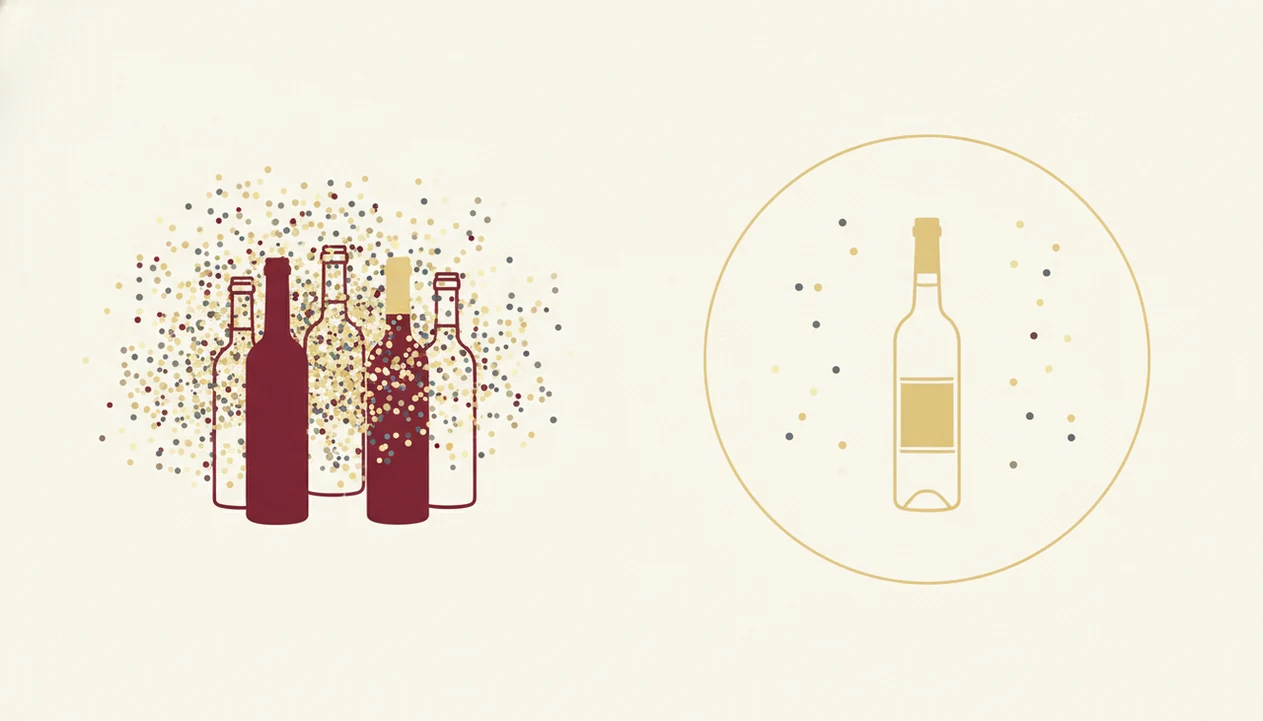
Data sparsity means there are too few scans, listings, or sales to support a tight wine value estimate. It is the reason app accuracy often drops for rare, old, or low-volume bottles.
Popular supermarket wines usually have more data. If thousands of people scan the same New Zealand Sauvignon Blanc, the model has a decent baseline. A 1986 bottle from a small producer may have no recent transaction record at all. The app can still identify it, but the price may carry wide error bars.
I notice this most when a cream back label has tiny importer text and the front label looks familiar, but the vintage is stained. The app may know the wine family. It may not know what that exact bottle is worth now.
Apps could show confidence ranges, such as “limited recent data” or “estimated from related vintages.” Most still do not. For rare bottles, cross-reference specialist merchants, auction archives, and collector forums before trusting the app number.
Four Common Myths About Wine Price Data Accuracy
Myth 1: The app price is a guaranteed resale price. Reality: it is an estimate built from available data, not an offer from a buyer.
Myth 2: AI makes wine price data perfectly accurate. Reality: AI can read labels, compare records, and standardize lookup behavior. It still depends on incomplete listings, uneven scans, and unpredictable demand. Good AI-powered wine identification and cellar management apps deliver faster bottle matching and structured value clues, not a private auctioneer in your pocket.
Myth 3: All wines have equally reliable data. Reality: frequently scanned wines usually have stronger price signals than rare estates, back vintages, or emerging-region bottles. The same pattern appears in broader app accuracy questions, including whether are wine scanner apps accurate for unusual labels.
Myth 4: One global average is enough. Reality: serious valuation needs local market context, sales channel, condition, and timing. A global midpoint can be useful, but it can also hide the number that matters in your city.
Tap, check, adjust.
Specific Guarantees Wine Identifier App Makes About Price Data
Prices in tools like Wine Identifier App are informational estimates, not formal appraisals, purchase offers, or guaranteed resale values. The number is meant to help you understand a bottle, compare rough value, and decide whether more research is worth your time.
Data is refreshed regularly, but not in real time. A merchant can sell out, an auction can reset demand, or a tariff change can shift landed cost before the next update cycle. AI label scanning improves bottle identification accuracy; it does not make price certainty possible.
That distinction matters when you’re standing by a cellar shelf with chalk marks on shelf tags and wondering which bottles are worth documenting first. The app can help triage. It should not be the only evidence for insurance, estate settlement, donation valuation, or legal disputes.
For formal value, use an app estimate as a starting note, then ask a qualified appraiser or auction specialist.
What Wine Price Data in Apps Does NOT Cover
Wine price data in apps usually does not cover the physical facts that a buyer checks before paying. A label scan can identify the bottle, but it cannot verify fill level, seepage, cork movement, heat exposure, label damage, or storage history.
Condition and provenance are not minor details. Auction research has found 10 to 20 percent premiums, and sometimes more, for bottles with stronger condition or documented provenance. A half-torn import sticker near the punt might not hurt drinkability, but it can matter when someone is paying collector money.
Most app prices also exclude local taxes, import duties, seller fees, auction commissions, shipping insurance, and currency conversion. Future critic re-ratings are outside the model too.
For legal, insurance, estate, or investment decisions, professional appraisal is the safer route. If the issue is whether the app can even identify a suspicious bottle, the separate question is whether can wine app identify counterfeit bottles, which requires different evidence than price data.
When to Get a Professional Wine Appraisal
Get a professional wine appraisal whenever the number will affect money, ownership, taxes, insurance, or a legal record. An app estimate is best for early triage: it helps you decide which bottles deserve closer attention, not what they are definitively worth.
Use specialist help sooner for rare, old, or high-value bottles, especially if the app shows a wide range or different tools disagree. Conflicting app prices are not proof that one app is wrong; they are a prompt to verify the bottle against auction specialists, regional merchants, and current demand.
- Use the app first to sort the cellar into ordinary bottles, possible collectibles, and bottles needing verification.
- Gather clear photos of the front label, back label, capsule, cork area, fill level, and any damage.
- Collect receipts, storage records, shipping history, cellar notes, and provenance documents before asking for a formal opinion.
- Contact a qualified appraiser for insurance schedules, estate work, tax filings, charitable donation valuation, or legal disputes.
- Ask an auction specialist when the bottle is old, scarce, unusually expensive, or likely to attract collector bidding.
Limitations: Wine Price Data Accuracy Gaps
App-based wine price data has real limits, especially when the bottle is valuable, rare, damaged, or hard to verify.
- Crowdsourced data is biased toward active markets, popular regions, and bottles people scan often.
- Rapid tariff, currency, or supply-chain shifts can make a stored price stale overnight.
- Expert scores explain only about half of price variation in typical models; the rest comes from market noise, scarcity, brand, and timing.
- No app can verify bottle condition, provenance, fill level, cork health, or storage history from a label scan alone.
- Rare wines and emerging-region bottles often lack enough scans or sales for meaningful estimates.
- A single global average may diverge from your local retail shelf, auction market, or private resale value.
- AI models trained on historical data may miss sudden demand shifts, critic re-ratings, or producer news.
However, the limitation is not a reason to ignore app pricing. It is a reason to label the number correctly. Use it as a quick tasting note for value, then add receipts, storage notes, and photos if the bottle matters.
FAQ: Wine Price Data Accuracy Questions
Can I sell wine at the app price?
No. An app price is an estimate, not a guaranteed offer, bid, or resale promise.
Why do wine apps show different prices?
Wine apps use different retailer feeds, auction records, user data, refresh cycles, and pricing models. That is why the same bottle may show different estimates.
Are AI wine valuations accurate?
AI wine valuations can be useful for quick estimates, but they are limited by data quality and market unpredictability. Wine Identifier App uses pricing as guidance, not appraisal.
Does bottle condition affect wine value?
Yes. Condition and provenance can shift wine value by 10 to 20 percent or more, and apps cannot assess that from a label scan alone.
Are rare wine prices reliable in apps?
Rare wine prices are usually less reliable because fewer scans and sales create wider error margins. Specialist merchants and auction records are better checks.
Should I insure wine at app value?
No. Insurance and estate valuation should rely on professional appraisals, not app estimates alone.
How often do wine app prices update?
Most wine app prices update on periodic refresh cycles, not live market feeds. Wine Identifier App data may lag sudden retail, auction, or currency changes.
Do taxes and shipping affect app prices?
Yes. Most app prices exclude local duties, sales tax, shipping, and insurance, which can create a large gap from shelf price.