AI Wine Recommendations Based on Taste, Food, and Cellar Context


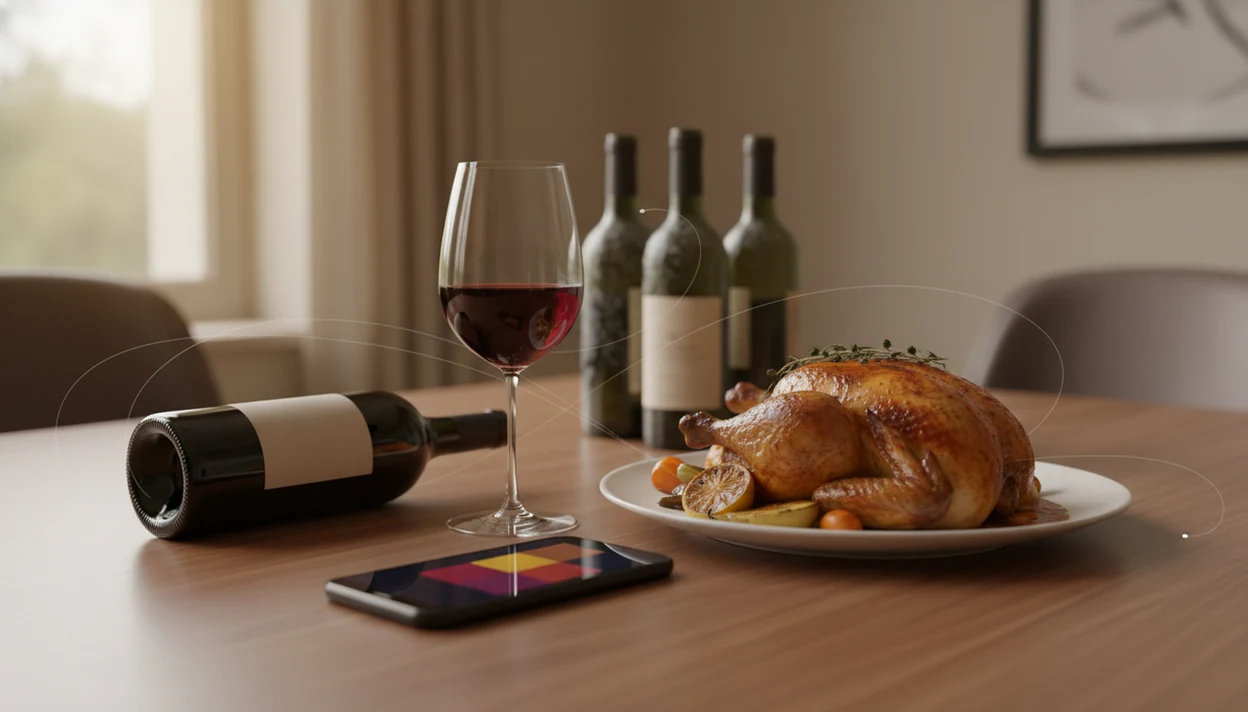
AI wine recommendations work by analyzing your flavor preferences, past ratings, community signals, and cellar inventory to suggest bottles you are most likely to enjoy with a given meal or occasion. A wine recommendation engine combines label recognition, style similarity, and food-pairing logic so every suggestion feels personal rather than generic. The technology improves with every rating you log, but it still has blind spots around mood, social context, and data bias.
> An AI wine recommendation engine is a software system that uses machine learning to match a wine drinker's stated or inferred taste profile against flavor descriptors, grape data, regional styles, community ratings, and cellar inventory to predict which bottles that person will enjoy most.
- AI wine recommendation engines analyze taste profiles, grape varieties, regions, ratings, and food context to suggest bottles you'll like.
- A wine identifier app can link label scans to your cellar and taste history, creating one continuous recommendation loop from store to table.
- These systems improve with feedback but still struggle with mood, social context, data bias, and the cold-start problem for new users.
Try the ai wine recommendations app on iPhone to scan a label and save the bottle.
What AI Wine Recommendations Actually Mean
AI wine recommendations are personalized bottle suggestions generated from your taste history, food context, and similar drinker patterns. They are different from generic “top rated” lists because they ask, “What fits you tonight?” rather than “What did the crowd score highest?”
A staff pick can be helpful. So can a shelf tag. But neither knows that you keep favoriting peppery reds, avoid oaky Chardonnay, and usually drink wine with tomato pasta on Wednesdays.
Modern recommender systems learn from behavior across large datasets. A 2020 Nature review reported that recommender systems often operate on datasets with millions of users and items, which helps explain how fine-grained preference matching became possible source. In wine, the “items” are bottles, grapes, regions, styles, ratings, and tasting words.
AI is still decision support, not a sommelier in your pocket. A good suggestion narrows the shelf. You still get the final pour.
Five Facts Every Wine Drinker Should Know About Recommendation Engines
- A wine recommendation engine needs more than ratings. It may analyze flavor profiles, grape varieties, regions, purchase histories, saved bottles, and your quick tasting note after dinner.
- Personal wine recommendations combine several signals at once. Stated taste, community behavior, style similarity, price range, and meal context all help the system avoid flat “popular wine” answers.
- Label recognition makes the loop practical. When you scan the front label, the app can connect that bottle to your cellar, ratings, and future food suggestions.
- Feedback improves the model. Rate wines you loved, wines you disliked, and the “fine, but not again” bottles. That middle category matters more than people think.
- AI still misses human context. It may not know that the first sip after the server pour felt too sharp because the room was loud, the food was late, and everyone wanted dessert.
Save it before you forget.
Before You Start: Inputs AI Wine Recommendations Need
Before asking for AI wine recommendations, give the app enough clean context to avoid a generic answer. The useful setup is simple: bottle identity, honest feedback, the situation at hand, and a clear privacy boundary.
- Confirm the app can recognize the details that actually shape a recommendation: label, producer, vintage, grape, and region. If it only sees “red wine,” the result will be blunt.
- Add a small set of real ratings, not just trophy bottles. Include the Pinot you loved, the oaky white you disliked, and the weeknight bottle that was merely fine.
- Choose your budget, meal context, and occasion before you ask. A $25 bottle for spicy takeout and a cellar pull for roast lamb are different requests.
- Check what is already available in your cellar or shopping list so the engine can suggest something you can actually open.
- Review privacy settings before uploading purchase history, location data, or cellar value. Those details can make recommendations smarter, but they also reveal buying habits.
How an AI Wine Recommendation Engine Works
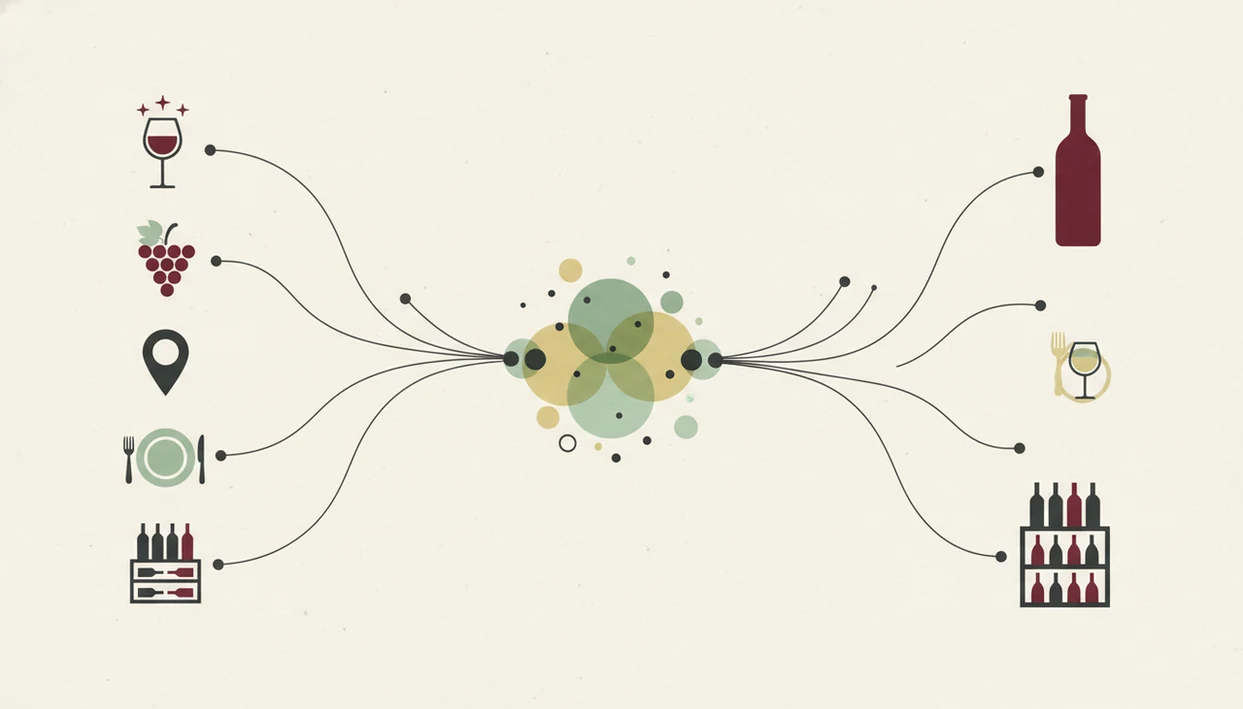
A wine recommendation engine works by combining user behavior, bottle attributes, and context into a prediction score. In plain terms, it compares what you like with what similar drinkers liked, then checks whether the bottle style fits the meal or moment.
Collaborative Filtering and Community Signals
Collaborative filtering looks for overlap between people. If drinkers who liked your favorite Rioja also rated a certain Douro red highly, the system may suggest it. This helps when tasting words are messy or missing.
Content-Based Style Similarity Scoring
Content-based filtering compares the wine itself. Grape, region, oak use, body, acidity, tannin, and descriptors all matter. The useful part is translation: the engine can connect “black cherry and leather” with a casual note like “smooth and not too dry.”
Hybrid Models That Merge Both Approaches
Most serious systems use a hybrid model. Food-pairing logic then layers on top, so spicy curry steam over rice bowls does not receive the same suggestion as lemony roast chicken.
Personalization is valuable when it works. A 2021 McKinsey analysis found that personalization at scale can lift revenue by 10 to 15 percent for consumer-facing companies source. Research on AI-based wine evaluation has found that machine-learning models can predict wine-quality scores from structured chemical or sensory data, but those models still depend heavily on the quality and representativeness of the training set source.
How to Use AI Wine Recommendations in a Wine Identifier App
To get better AI wine recommendations, you need to close the loop between discovery, drinking, and cellar tracking. One label scan is a start, but your ratings and context teach the system what “good” means for you.
- Scan a label to identify the bottle and seed your taste profile with grape, region, producer, and vintage.
- Rate the wine after drinking it, then add a quick tasting note like “bright cherry, too much oak” or “good with pizza.”
- Build your cellar inventory so the engine knows what you own, what is gone, and what has duplicates.
- Set meal or occasion context before asking for a suggestion, especially if dinner has heat, cream, smoke, or citrus.
- Review the recommendation and mark thumbs-down when it misses, not just favorite-it when it works.
Tools like Wine Identifier App can make this loop easier because the same scan can feed bottle identity, notes, cellar status, and pairing prompts. For dinner-specific workflows, a wine pairing app guide can help you think through the food side first.
If you already use Vivino, Delectable, or CellarTracker, compare the same bottle across tools and keep the recommendation history in one place so your palate signals do not get scattered.
Four Inputs That Shape Personal Wine Recommendations
Personal wine recommendations usually depend on four inputs: taste history, food context, cellar status, and community behavior. The more complete those inputs are, the less the app has to guess.
Taste History and Rating Feedback
Ratings tell the engine direction. Notes explain why. “I liked the red one from dinner, but I have no idea what it was” becomes much easier to solve when the bottle has a photo, stars, and two plain words.
Food Pairing and Occasion Context
Food context changes the answer. A bottle that feels soft with supermarket goat cheese may taste dull beside smoky barbecue. Recipe detail helps more than a broad category.
Cellar Inventory as a Recommendation Signal
Cellar status tells the system what you can drink now. It can avoid bottles you already opened, spot duplicates, and suggest aging a structured red instead of pulling it too early.
Community behavior fills gaps. If similar palates keep rating a lesser-known grape highly, the system can offer discovery without tossing you into random shelves.
Common Myths About AI Wine Recommendations
AI wine recommendations are not random picks. They are based on learned patterns from your behavior, bottle data, and the choices of people with similar taste histories.
Another myth is that AI only recommends famous or expensive bottles. A broad dataset can surface affordable producers, overlooked regions, and weekday wines that match your profile better than a trophy label. Price still needs a setting, though. If you do not enter a budget, the app may not know where your comfort line sits.
AI also does not replace a human sommelier. It helps non-experts narrow a restaurant list, remember past bottles, and ask clearer questions. A restaurant wine menu scanner can be useful when the wine list is folded around the dessert menu and nobody wants a ten-minute debate.
Uploading one label does not mean the system knows your palate. It knows the bottle. Personalization takes ratings, notes, dislikes, and time. Gartner projected in 2019 that 80% of marketers would abandon personalization efforts by 2025 because of ROI, data-management, or customer-trust challenges source. The hard part is not the word “AI.” It is useful feedback.
Common Mistakes When Training a Wine Recommendation Engine
The biggest mistake is only rating wines you love. A recommendation engine also needs negative signals, or it may keep suggesting the same heavy red you politely finished once.
Skipping tasting notes is another quiet problem. Stars say “how much.” Notes say “why.” A note like “peppery finish with roast lamb” gives the system more useful information than a lonely 4-star score.
Cellar neglect causes bad suggestions too. If you drank the magnum wedged on the bottom rack but never removed it, the app may recommend a bottle that no longer exists. Annoying, but fixable.
Food context also matters. Do not expect exact pairing suggestions if you only say “dinner.” Tomato pasta, steak, and Thai noodles pull wine in different directions. The app to help choose wine for dinner use case works better when the meal is specific.
Expect a ramp-up period. Cold-start users get broader suggestions until enough ratings build a pattern.
How to Verify Your AI Wine Recommendations Are Improving
You can verify improvement by tracking hit rate: the share of recommended bottles you later rate 4 stars or higher. Keep it simple. Ten suggestions, six strong hits, two okay bottles, two misses.
Compare month 1 with month 3. Better recommendations should show more accuracy, but also smarter variety. If the engine only repeats Sauvignon Blanc forever, it may be safe rather than helpful.
Look for new regions or grapes that still feel like you. A crisp Albariño suggestion after several mineral white ratings is a good sign. A random high-alcohol red with no link to your history is not.
Meal feedback matters too. For recipe-heavy dinners, an app that pairs wine with recipes can show whether the recommendation matched the actual plate, not just the bottle profile.
For casual drinkers, a simple hit-rate check is often better than obsessing over expert scores because it measures whether the recommendation worked at your table.
Limitations
AI wine recommendations are useful, but they cannot understand every reason a bottle works in real life. Good AI-powered wine identification and cellar management apps deliver faster bottle recognition, smarter pairing prompts, and better memory of your preferences, not a guarantee that every pour will fit the room.
- Filter bubbles can form. Overfitting to past choices may keep you inside familiar grapes and regions.
- Mood is hard to model. Rainy weather, a tense dinner, or a birthday toast can change what tastes right.
- Training data has bias. Regions with more ratings, higher prices, or stronger critic coverage may appear more often.
- New users get generic results. Cold-start profiles need ratings before personal wine recommendations become sharp.
- Pairing rules simplify food. Fusion dishes, fermented heat, and unusual sauces can confuse standard pairing logic.
- Vintage variation is often thin. The same wine can change across years, even when the label looks nearly identical.
- Privacy deserves attention. Purchase history, location signals, ratings, and cellar value can reveal more than expected.
Read the settings screen. Seriously.
FAQ
How accurate are AI wine recommendations?
AI wine recommendations become more accurate as you rate bottles, log dislikes, and add tasting notes. They are never perfect because mood, food details, and social context are hard to model.
How many ratings before AI learns my taste?
Many users start seeing useful patterns after 10 to 20 honest ratings. More ratings usually help, especially when they include both favorites and wines you would not buy again.
Can AI recommend wines for food pairing?
Yes, AI can recommend wines for food pairing when you enter the dish, cuisine, or recipe style. Complex fusion dishes can still confuse simplified pairing rules.
Do wine recommendation engines cost money?
Many wine recommendation engines are included in free apps. Some platforms charge for premium cellar tools, price data, advanced recommendations, or larger storage.
Are AI wine recommendation apps private?
They may store ratings, purchase history, cellar data, label photos, and sometimes location signals. Check privacy settings before adding sensitive cellar or buying information.
Can AI suggest when to open aged wines?
Cellar-aware engines can estimate drinking windows from region, grape, vintage, and style. Vintage gaps and storage conditions can make those estimates imperfect.
Is AI better than a human sommelier?
AI scales well and remembers your preferences across many bottles. A human sommelier is better at reading mood, budget tension, table dynamics, and special occasions.
Are AI wine recommendations useful for beginners?
Yes, beginners can benefit from label scans, guided ratings, and plain-language flavor notes. Wine Identifier App, also known as DiVino, is most useful for beginners when they keep adding ratings, dislikes, and short plain-language notes over time.