Are Wine App Ratings Reliable for Buying Decisions?


The short answer to “are wine app ratings reliable” is: partially, they help identify broadly popular, mainstream wines but can be skewed by price bias, positivity inflation, and thin data on niche bottles. They are most useful as one signal among several, calibrated against your own tasting history and cellar data in an AI-powered wine identifier app.
Definition: Wine app ratings are crowdsourced average scores submitted by everyday drinkers, aggregated on platforms that let users scan labels, log tasting notes, and browse community reviews to guide purchase decisions.
TL;DR
- Community wine ratings cluster between 3.6–4.2 out of 5, so small score differences rarely indicate meaningful quality gaps.
- Price, label design, and brand reputation create measurable wine rating bias that inflates scores for expensive or well-known bottles.
- The smartest approach is to pair community ratings with your own tasting history inside an AI wine identifier app, not treat them as universal truth.
Try the are wine app ratings reliable on iPhone to scan a label and save the bottle.
What Wine App Ratings Actually Measure
Wine app ratings measure crowd preference, not objective wine quality. They are averages from non-expert drinkers who rate bottles after scanning a label, searching a wine, or saving a quick tasting note.
Most app scores sit in a tight band, often around 3.6–4.2 on a 5-point scale. That means a 3.8 and a 3.9 may feel different in the store aisle, but they rarely prove much by themselves. I see this most when comparing two supermarket reds beside pizza boxes after dinner; both look “good,” but the comments tell the real story.
The score also blends taste with expectation. Price, label design, brand familiarity, and social proof all nudge ratings. A bottle with a shiny known region can feel safer before anyone takes a sip.
Small samples are fragile. If a niche white has 12 ratings, one unhappy table can drag the average down. A good enough note, not a tasting exam, often tells you more.
Scope and Safety Notes for Using Wine App Ratings
Wine app ratings are informational buying signals, not objective guarantees that a bottle is high quality, safe, authentic, or worth the price. They can help you compare likely crowd appeal, but they cannot replace judgment about the actual bottle in your hand.
A score cannot confirm how the wine was stored, whether it is counterfeit, whether it contains allergens that matter to you, or whether alcohol is suitable for your body or situation. It also should not guide medical, pregnancy, addiction, employment, driving, or legal decisions. Alcohol choices need to follow local age, purchase, serving, and transport laws, plus any personal health advice you have received.
Use ratings with a simple safety check:
- Treat the score as a preference clue, not a promise.
- Inspect the bottle condition, closure, vintage, and seller before buying.
- Check labels or producer information for ingredients, allergens, and alcohol level when relevant.
- Follow your clinician’s advice, pregnancy guidance, recovery plan, or medication warnings over any app suggestion.
- Respect local alcohol laws and choose not to drink when safety, age, driving, or health makes alcohol inappropriate.
How Community Wine Ratings Work Behind the Scenes
Wine app ratings usually start when a user scans a front label or searches for a bottle, then submits a star rating and optional tasting note. The app matches that bottle to a database record, groups the reviews, and displays an average score.
Behind that simple number, platforms may use aggregation rules. Some apps average every rating equally. Others may weight recent reviews, verified purchases, active users, or cleaner bottle matches more heavily. The mechanism matters, but most drinkers never see it.
There is also a pattern called J-shaped positivity bias. In plain English, happy drinkers tend to rate more often than disappointed or neutral drinkers, so displayed averages lean high. The phone comes out when the wine pleased the table.
A wine identification and cellar-management workflow should identify the bottle, connect it to your past likes, and organize the memory, not declare one universal winner for every palate.
Personalized wine apps can layer your own preference data on top of raw community scores, but the crowd score still starts as crowd behavior.
5 Facts About Wine Rating Bias Every Buyer Should Know
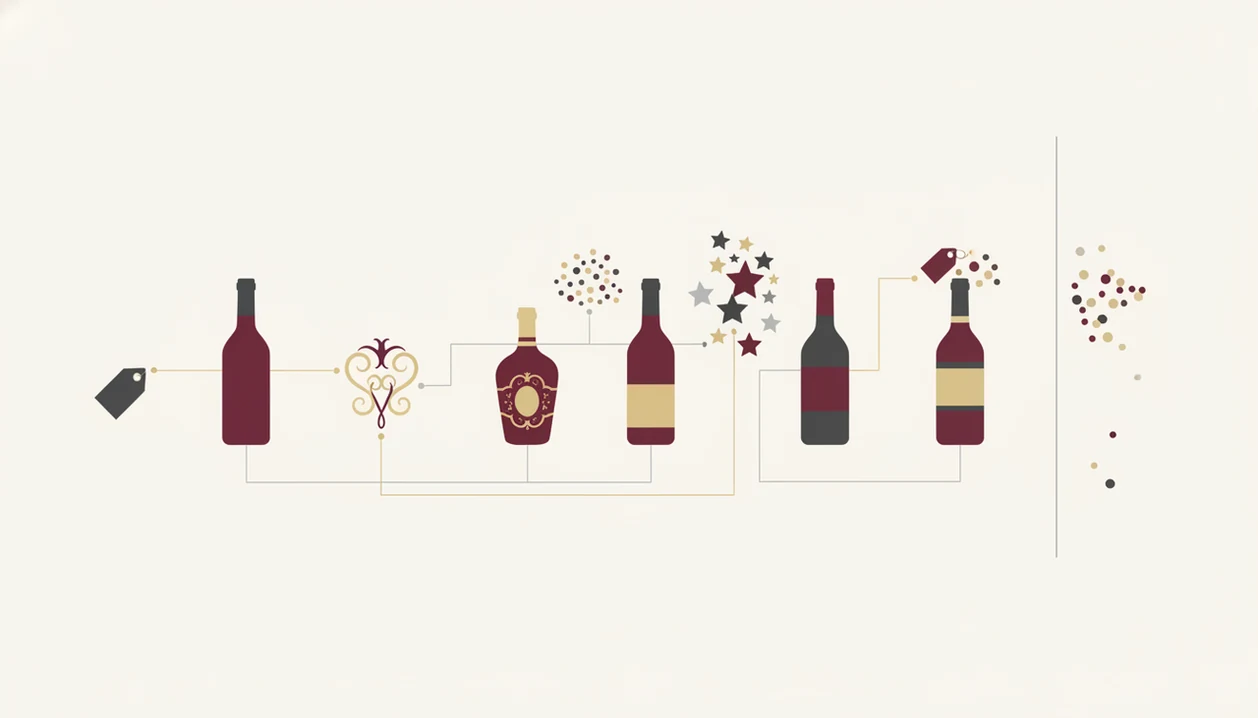
- Price changes perception. In an experiment with more than 6,000 blind tastings, people rated the same wine higher when told it cost more, showing clear price-driven wine rating bias. Source: Goldstein et al., Proceedings of the National Academy of Sciences, 2008: https://www.pnas.org/doi/10.1073/pnas.0706929105
- Non-experts struggle blind. A controlled study found casual consumers performed at chance level when asked to distinguish cheap from expensive wines blind. That should make any single crowd score feel less final.
- Critics disagree too. Research on expert wine scores has found average correlations around 0.3–0.5 between critics rating the same wines. Professional judgment is useful, but not identical. Source: Ashton, Journal of Wine Economics, 2012: https://www.cambridge.org/core/journals/journal-of-wine-economics
- Online ratings skew positive. Studies of online product ratings, including food and drink categories, show J-shaped distributions with many very positive reviews and fewer moderate or negative ones.
- Repeat scores move. A review of wine expert judgment notes that the same professional can vary by as much as 4 points on a 100-point scale when re-rating an identical wine.
For everyday buyers, community ratings are often more useful for spotting broad popularity than predicting personal delight because wine preference depends on style, context, and expectation.
Research Sources Behind This Reliability Assessment
This assessment leans on wine-specific blind-tasting work, expert-score research, and broader online-review studies. Together, they support the cautious view: app ratings are useful preference signals, not clean measurements of quality.
- Start with Goldstein and colleagues’ blind-tasting experiment for price bias, because it directly tested how stated price changes enjoyment ratings for the same wine.
- Add controlled consumer blind-tasting research on cheap-versus-expensive bottles, which explains why casual drinkers may not separate quality from expectation when price and label cues return.
- Use Ashton’s Journal of Wine Economics work for critic disagreement, plus related reviews of wine judging, to frame expert-score variation and repeat-rating movement.
- Bring in online-review research on J-shaped rating distributions to explain why many app averages lean positive: people are often more motivated to rate when pleased.
- Transfer the findings carefully. Price effects, crowd positivity, thin samples, and disagreement fit wine apps well. Lab blind tastings and critic panels transfer less perfectly, because app users rate in kitchens, stores, restaurants, and different moods, often after seeing the label, meal, price, and friends’ reactions.
When Community Wine Ratings Are Most and Least Reliable
Community wine ratings are most reliable for popular, recent-vintage, mainstream-style wines with hundreds or thousands of ratings. A widely sold California Cabernet or Marlborough Sauvignon Blanc has enough drinkers to smooth out a few odd reviews.
They are least reliable for aged bottles, tiny-production wines, niche regions, natural wines, and experimental styles. Those bottles may have thin data, polarized opinions, or reviews from people expecting something completely different. A cloudy orange wine can be loved by one group and punished by another.
Small gaps are noise. Differences of 0.1–0.2 points are usually not meaningful at typical sample sizes, especially when you don't know how the app weights older ratings. The by-the-glass column with crossed-out vintages tells the same story: the exact bottle in front of you may not match the tidy database entry.
Unrated or low-rated wines are not automatically bad. They may simply lack exposure, distribution, or enough people who bothered to scan the front label.
Common Myths About Wine App Scores
Myth one: a 4.0 in the app equals expert-level quality. Reality: community wine ratings and critic scores measure different things. One captures broad user satisfaction; the other reflects trained evaluation within a formal tasting frame.
Myth two: thousands of high ratings mean the wine is right for everyone. Reality: crowd averages erase personal palate differences. If you dislike heavy oak, a famous 4.2 red can still be the wrong bottle for your weeknight bowl of tomato pasta.
Myth three: low-rated or unrated wines are bad. Reality: they may be niche, newly released, imported in small quantities, or missed by app users. The receipt tucked inside a wooden wine crate may tell you more than a lonely average.
Myth four: crowdsourcing cancels all bias. Reality: systematic effects like price, label design, critic reputation, and region prestige can persist across large samples.
If the scan itself is the question, our guide on are wine scanner apps accurate explains label matching separately from rating reliability.
How to Read Wine App Ratings Without Getting Misled
Use wine app ratings as a filter, then slow down for the details. The average score is the first clue, not the buying decision.
- Check the number of ratings. Ignore or heavily discount averages with fewer than 30–50 reviews.
- Read the distribution. Look for split patterns, such as many 5-star and many 2-star reviews.
- Scan written tasting notes. Match descriptors to your preferences, like crisp, sweet, oaky, earthy, or high-acid.
- Compare one critic score. If available, use it as a second lens, not a tie-breaker from above.
- Log your own rating. Save your reaction after tasting so the app can learn what you actually like.
Do it while the bottle is still on the counter. At 10:40 p.m., with plates still out, nobody remembers the producer name cleanly. Tap, check, adjust, then save it before you forget.
For buyers choosing from a shelf, a written note that matches your taste is often more useful than a 0.1-point score advantage because it describes the actual drinking style.
What a Wine Identifier App Adds Beyond Community Ratings
A wine identifier app adds context that a raw community average cannot provide. Scan-to-identify can show the bottle, vintage, grape, region, community score, and AI-generated pairing suggestions in one place.
The real value appears after you save your own history. Cellar tracking and tasting notes create a personal taste profile, so a generic 3.8 can be re-weighted against what you liked before. If you keep favorite-it-for-next-time notes on bright whites with sushi, the app should learn that pattern.
Tools like Wine Identifier App can help connect label recognition, pairing prompts, cellar records, and bottle memory. The reinforcement matters when your camera roll has six similar bottle photos buried between dog pictures, receipts, and a blurry restaurant menu.
AI can also surface hidden gems the crowd may miss. However, it still depends on the quality of community input, bottle matching, and your own saved notes.
For the image side of the workflow, can AI identify wine from photo covers what label recognition can and can't infer.
Limitations
Community wine ratings are useful, but they are not neutral instruments. Treat them as social taste data with gaps.
- Community scores blend perceived status, label appeal, price expectation, and social proof with actual taste.
- Many wines have too few ratings for a statistically meaningful average.
- Rating scales differ across platforms, including 5-star, 100-point, thumbs up, and hybrid systems.
- Users apply scales inconsistently; one person's 3.5 can mean “fine,” another's can mean “never again.”
- AI personalization still depends on the breadth and accuracy of the underlying community data.
- Research cited here studied general consumers, critics, and online ratings; results may not transfer perfectly to every app's user base.
- No community rating system fully accounts for bottle variation, storage conditions, serving temperature, or glassware.
- Vintage matching can be messy when a stained vintage year or half-torn import sticker makes the bottle harder to confirm.
For cellar decisions, rating confidence should be paired with storage notes, drink windows, and wine price data accuracy, especially for bottles you plan to keep.
FAQ
Do wine app ratings match expert scores?
Wine app ratings can loosely align with expert scores for popular, widely reviewed wines. They often diverge for niche bottles, older vintages, and styles with polarized audiences.
Does price bias affect wine ratings?
Yes. Blind-tasting research shows that telling people a wine costs more can measurably raise enjoyment ratings for the same wine.
How many ratings make a score trustworthy?
Scores with fewer than 30–50 ratings are statistically fragile and easy to skew. Larger samples are more useful, but they still do not remove systematic bias.
Why do most wine apps skew positive?
Many wine apps show positivity bias because satisfied drinkers are more likely to leave ratings. This creates J-shaped distributions with many high scores and fewer neutral reviews.
Are unrated wines worth buying?
Yes, unrated wines can be worth buying. Lack of ratings often reflects low exposure, small production, or limited distribution rather than poor quality.
Can I compare scores across wine apps?
Cross-app comparisons are unreliable because platforms use different scales, user bases, and weighting methods. A 4.0 in one app may not equal a 4.0 elsewhere.
Do even wine critics disagree on scores?
Yes. Studies of expert wine ratings report critic correlations around 0.3–0.5, which means professional disagreement is common.
Can AI fix community rating bias?
AI personalization can re-weight community ratings around your own palate and saved history. It cannot fully fix bias if the underlying community data is thin, skewed, or incorrectly matched.