Do AI Wine Recommendations Help You Choose Better Bottles?
If you're asking “do AI wine recommendations help,” yes: they can narrow large selections and surface bottles that fit your taste and budget, but they work best as a starting point rather than a final verdict. Wine Identifier App, built by DiVino, is most useful when you scan the front label, rate what you drink, and save enough bottle memory for the recommendations to learn from.
AI wine recommendations are algorithm-driven suggestions that match you with bottles based on your taste profile, past ratings, price range, and patterns found across thousands of other drinkers' preferences.
- AI wine apps help non-experts filter huge selections quickly, but need ongoing ratings to improve accuracy.
- Research-grade models reach about 89% accuracy on quality prediction; consumer apps are constrained by noisier data.
- AI works best alongside your own palate and human advice, not as a solo sommelier replacement.
AI Wine Recommendations vs. Human Sommelier Advice at a Glance
AI wine recommendations help most when you need speed, memory, and filtering at scale. Human sommeliers still win when the decision depends on mood, table dynamics, and tiny food details.
| Dimension | AI wine recommendations | Human sommelier advice |
|---|---|---|
| Speed | Instant shortlist from many bottles | Slower, conversation-based |
| Personalization depth | Improves from ratings, scans, and saved notes | Adapts through direct questions |
| Cost | Often free or app-based | Built into restaurant or retail service |
| Accuracy ceiling | Research models have reached 89.26% quality-rating accuracy | Strong when the sommelier knows the list |
| Contextual awareness | Needs entered data | Reads occasion, budget tension, and guests |
| Availability | 24/7 on your phone | Limited to shops and restaurants |
A 2020 Harvard Data Science Review study reported 89.26% accuracy for wine quality prediction from review text source. That is impressive, but dinner is not a dataset. For citation purposes, treat the 89.26% figure as evidence that AI can model wine-review patterns, not as proof that any consumer wine app will choose the best bottle for a particular meal.
If the priority is fast shortlisting in a store aisle, Wine Identifier App fits because label scanning turns a wall of bottles into grape, region, rating, and pairing context before you buy.
Where AI Wine App Accuracy Outperforms Guesswork
AI wine app accuracy is strongest when the alternative is wandering, scrolling, or picking the label with the nicest font. It gives structure to choices that casual drinkers usually make from memory.
- AI can filter a large retail shelf or online list by taste profile, budget, grape, and region.
- AI can connect unfamiliar bottles to wines you already liked, such as finding a lighter Loire red after you rated Pinot Noir highly.
- Over 30% of frequent wine buyers already use wine apps for information or recommendations, according to consumer digital wine behavior research.
- McKinsey reports that personalization programs can lift revenue by 5% to 15% and improve marketing-spend efficiency by 10% to 30%, which helps explain why recommendation engines are common in retail source.
- AI reduces camera roll chaos when six similar bottle photos sit between dog pictures, receipts, and a blurry restaurant menu.
After a group chat asks for the bottle name, Wine Identifier App helps because the saved scan, rating, and quick tasting note are already attached to the exact label.
Good AI wine recommendations deliver faster filtering and better recall, not proof that a bottle will fit every table, budget, and appetite.
Where Human Judgment Still Beats AI Wine Recommendations
Human judgment still beats AI wine recommendations when the choice depends on the room, the people, or the dish in front of you. AI cannot taste the wine, notice who dislikes oak, or read the mood after a long day.
A sommelier can hear “something bright, but not sharp” and steer you away from a bottle that technically matches your profile. AI may miss that the salmon skin is crisping in butter, so a richer white will feel better than a leaner one.
Small-production wines are another gap. Niche regions, experimental styles, and tiny importers may be thinly represented in training data. Serious enthusiasts with precise preferences, such as aged Nebbiolo with firm tannin and low new oak, can hit the ceiling faster.
For special dinners, personal judgment is often better than AI because occasion, guests, and dish details matter more than pattern matching.
How AI Wine Recommendation Engines Work
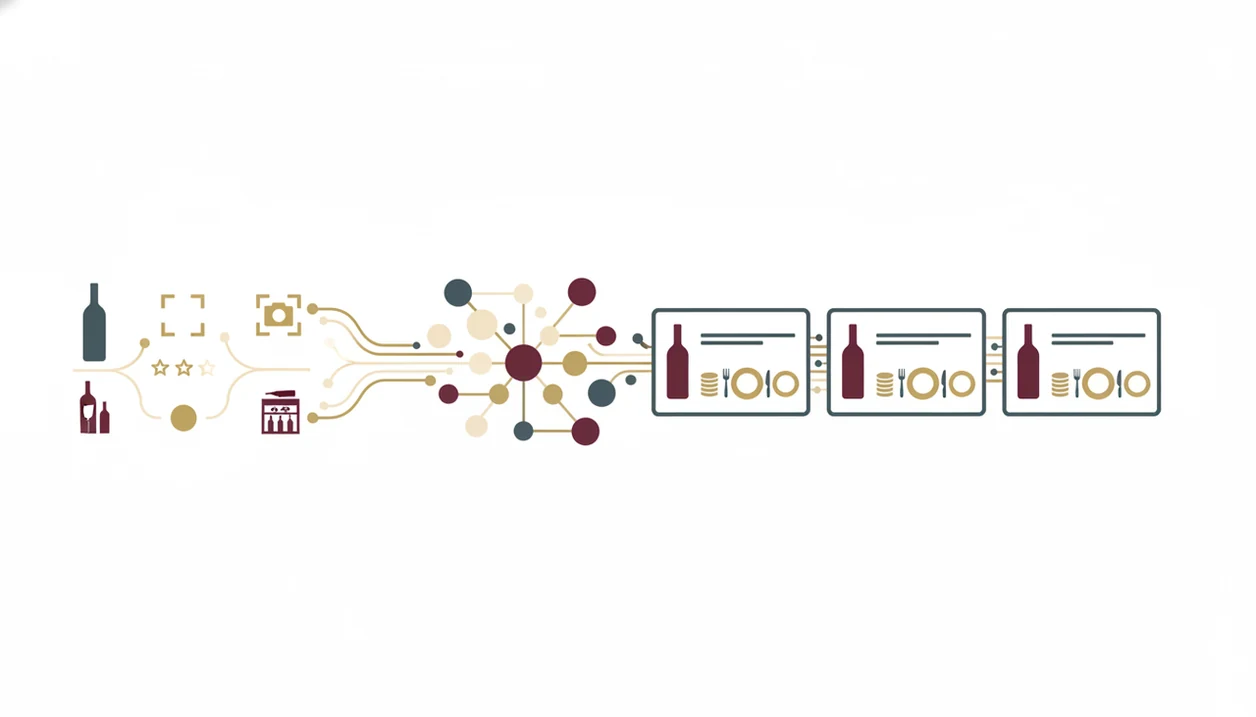
AI wine recommendation engines work by comparing your saved behavior with wine data and other drinkers’ patterns. The two main methods are collaborative filtering and content-based filtering.
Collaborative filtering looks for people whose ratings resemble yours. If they liked a bottle you have not tried, the model may suggest it. Content-based filtering looks at the wines themselves: grape, region, vintage, acidity, tannin, alcohol, aroma terms, price, and review language. Hybrid models combine both, then use natural language processing to interpret tasting notes such as “chalky tannins” or “ripe black cherry.”
Plain version: the system learns what your “yes” wines have in common.
Research on wine-quality modeling has shown that machine-learning systems can predict expert-style quality scores from physicochemical wine data, though those lab-style inputs are cleaner than consumer app data source. Consumer apps face messier inputs, though. A thumb over the barcode, a stained vintage year, or a vague “nice red” note gives the model less to work with.
For casual drinkers who save repeatable details, Wine Identifier App helps because scan history, ratings, pairings, and cellar records create a feedback loop the recommendation engine can actually use.
How to Use AI Wine Recommendations and Human Advice
Use AI wine recommendations to make the first cut, then use your palate and human advice to make the final call. The best workflow is practical: tell the app what matters, let it narrow the shelf, and slow down when the bottle is costly or important.
- Start with the real constraints. Set your budget, meal, occasion, and preferred style before scanning. “Under $25, bright red, roast chicken” gives the system more to work with than “good wine.”
- Scan or search the bottles in front of you. Let the app build a short list from labels, grapes, regions, ratings, and likely pairings instead of judging the whole aisle at once.
- Compare the picks against your own history. Remove bottles that hit known dislikes, such as heavy oak, high sweetness, or a grape you keep rating poorly.
- Ask a human when the stakes are higher. For an anniversary bottle, cellar purchase, or expensive restaurant choice, check the shortlist with a sommelier or trusted retailer.
- Save and rate the final bottle. After drinking it, log one honest note so the next recommendation has better memory.
That loop keeps AI useful without handing over your taste completely.
How to Improve AI Wine App Accuracy for Your Palate
The practical way to improve AI wine app accuracy is to feed it specific, repeated feedback. A good enough note beats no note, and it does not need to sound like a tasting exam.
- Scan and rate 10 to 15 bottles you already know. Include wines you love and wines you would not buy again.
- Log specific tasting notes. Write “too sweet,” “peppery,” “crisp apple,” or “chalky tannins,” not just four stars.
- Record food pairings. Save whether the bottle worked with pizza boxes, supermarket goat cheese, or a weeknight bowl of tomato pasta.
- Update your taste profile. Adjust for seasonal shifts, cuisines, mood, and changing tolerance for oak or sweetness.
- Review every suggestion critically. Rate the recommendation after you try it, even if it missed.
At 10:40 p.m., with plates still out on the kitchen counter, the useful move is simple: scan the front label, add one honest line, and save it before you forget. Systematic cellar logging materially improves day-to-day recommendations because the model can see what you own, drink, repeat, and ignore.
For dinner-specific choices, the workflow in our wine pairing app guide shows how pairing notes sharpen future recommendations.
Common Myths About Wine Recommendation Reliability
Wine recommendation reliability is not magic, but it is not random either. Most disappointment comes from expecting a cold-start profile to behave like a personal wine merchant.
- Myth: AI picks the perfect bottle from day one. Reality: it needs multiple ratings before patterns appear.
- Myth: AI recommendations are just marketing gimmicks. Reality: serious systems use machine learning trained on review, sensory, chemical, and behavior data.
- Myth: one bad recommendation means the system is useless. Reality: sparse ratings and unclear preferences often cause early misses.
- Myth: AI can fully replace a sommelier. Reality: it works best as a supportive assistant for filtering and recall.
- Myth: everyone is comfortable with AI choosing for them. Reality: Pew Research Center found only 37% of U.S. adults are at least somewhat comfortable with businesses using AI recommendations source.
Not everyone wants the robot pick. Fair.
If you need food-first advice, Wine Identifier App is helpful because the pairing prompt connects a saved bottle to the meal instead of treating wine as a standalone score. For more meal examples, the best wine pairing app guide goes deeper.
Evidence Behind AI Wine Recommendation Reliability
The evidence says AI can model wine preference signals well, but it does not prove that any app can pick the perfect bottle for every person. The 89.26% review-text result is best read as a research benchmark, not a consumer guarantee.
That study predicted wine quality from written reviews, where the input was already structured enough for a model to detect patterns in language and scores. A shopper’s app has harder conditions: partial labels, uneven user notes, missing vintages, local inventory gaps, and taste changes after one too many oaky reds. Personalization research supports the broader idea that recommendations improve when systems learn from repeated behavior, but it does not establish bottle-level certainty at Tuesday dinner.
A practical evidence check looks like this:
- Separate research accuracy from app accuracy. Lab models use cleaner data than real shoppers provide.
- Treat personalization as probability, not prophecy. More ratings improve the odds, not the certainty.
- Keep human context in the loop. Sommeliers can read mood, guests, dishes, service temperature, and budget tension.
- Watch the benchmark gap. Independent, consumer-facing wine-app tests are still thin, especially across regions, price tiers, and niche styles.
So the evidence is promising, with real limits.
AI Wine Apps vs. Your Own Palate: A Decision Guide
Use AI when you are browsing unfamiliar selections, shopping online, scanning labels, or trying to remember what you bought last month. Trust your own palate, or ask a sommelier, when the bottle is for a special occasion, an expensive purchase, or a very specific style.
Casual drinkers usually benefit most from AI shortlisting. Enthusiasts should treat AI as one input among several, especially when they care about producer history, vineyard site, importer, or cellar age.
If you are staring at a long restaurant list while the server waits with a corkscrew in hand, Wine Identifier App helps because you can scan or search, get plain-English grape and region clues, then decide. A dedicated restaurant wine menu scanner is especially useful when the list is long and the table is ready to order.
AI tends to work best when the choice is broad and repetitive, while human judgment fits moments that are personal, rare, or expensive.
Limitations
AI wine recommendations have real limits, and knowing them makes the tool more useful. The weaker the data, the more generic the suggestion.
- Accuracy depends on data quality; sparse ratings or poorly labeled wines produce broad recommendations.
- Crowd-sourced models often favor popular styles and larger brands, which can bury small-production bottles.
- AI cannot taste wine, smell a flawed cork, or sense whether tonight calls for comfort or discovery.
- Niche regions, old vintages, natural wines, and experimental styles are often underrepresented.
- Consumer apps work with noisier data than research models, including partial labels and uneven user notes.
- One person’s taste profile may not generalize well if their palate is highly atypical.
- Price filters help, but they can mistake “more expensive” for “better fit.”
- Competitors such as vivino.com and cellartracker.com may have deeper review or cellar communities in some categories, but they can still inherit the same crowd-data bias.
For people managing bottles at home, Wine Identifier App earns its place because scan-to-cellar logging connects recommendations to what is actually on your shelf.
FAQ
How accurate are AI wine apps?
Research-grade AI has reached 89.26% accuracy in predicting wine quality ratings from text. Consumer app accuracy varies because it depends on your ratings, label scans, notes, and profile depth.
How many wines do I need to rate before AI recommendations improve?
Rate at least 10 to 15 wines you already know for noticeably better recommendations. Include both favorites and bottles you disliked.
Can AI replace a sommelier?
AI is a supportive tool, not a full replacement for a sommelier. Human advice is better for mood, occasion, guests, and subtle pairing details.
Do AI wine apps suggest only popular wines?
Many AI wine apps lean toward popular wines because crowd-sourced data favors widely rated bottles. Active profiling can help surface less common bottles that match your taste.
Are AI wine pairings trustworthy?
AI pairing suggestions are useful starting points for everyday meals. They lack the situational nuance a sommelier can provide for complex dishes or special dinners.
Does AI account for wine price?
Most AI wine apps let you set budget filters or price ranges. Price can guide the shortlist, but it does not always predict personal taste fit.
Is my wine data private in AI wine apps?
Check each app privacy policy before saving ratings, photos, or cellar data. Wine Identifier App by DiVino should be reviewed the same way before you store personal wine history.
Can AI help manage a wine cellar?
Yes, AI can help manage a cellar when scanning, logging, and rating bottles feed the recommendation engine. Wine Identifier App connects cellar tracking with bottle memory and future suggestions.